
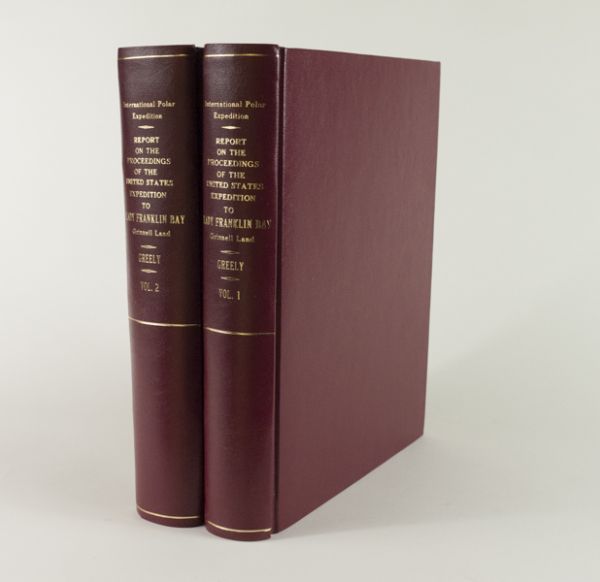
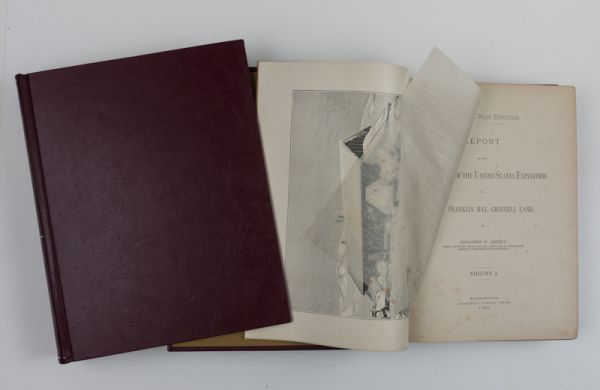
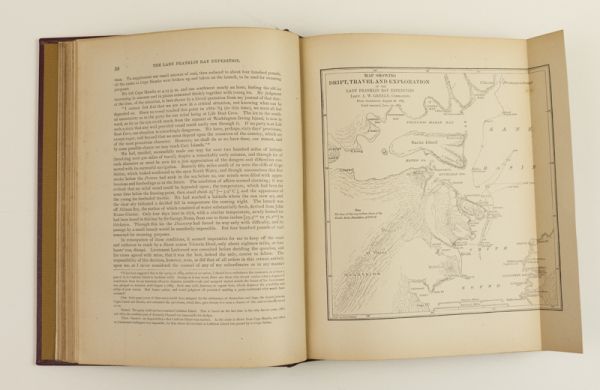
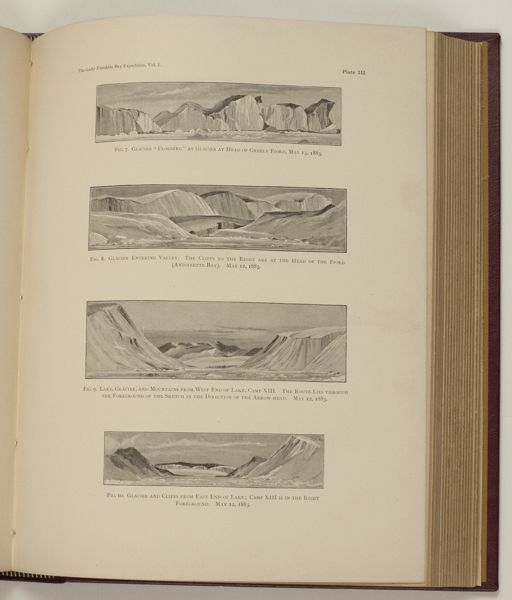
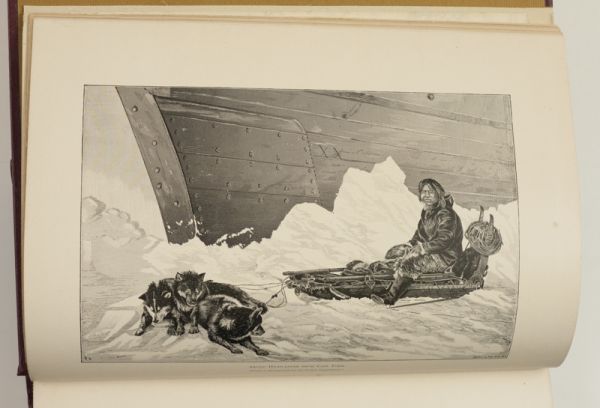
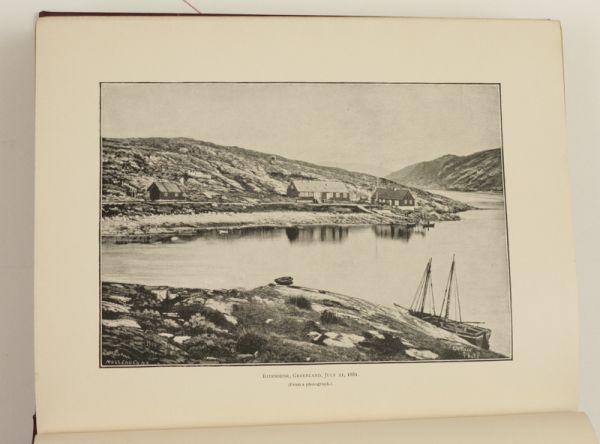
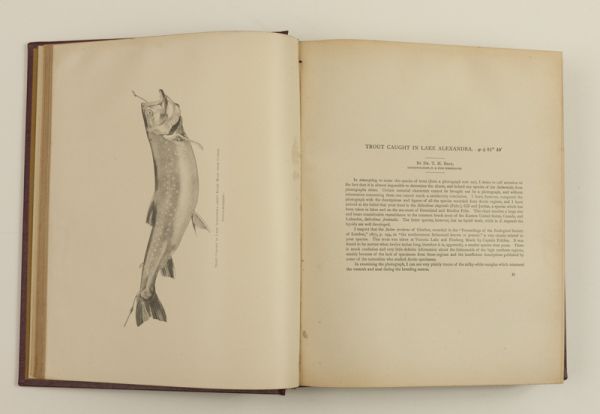
Report on the Proceedings Of The United States Expedition To Lady Franklin Bay, Grinnell Land.
By Greely, Adolphus W.
Washington, Government Printing Office, 1888. First Edition. large thick 4to. (30 cm).
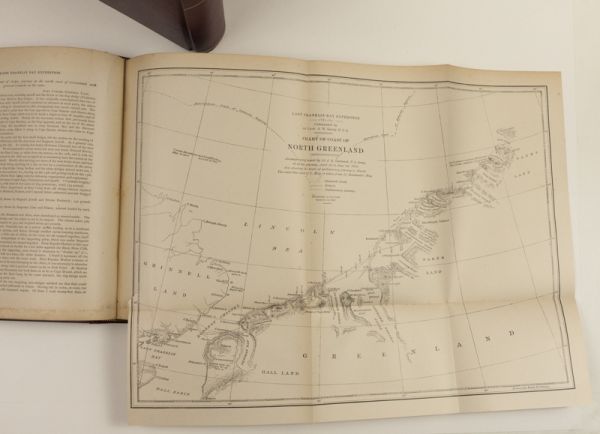
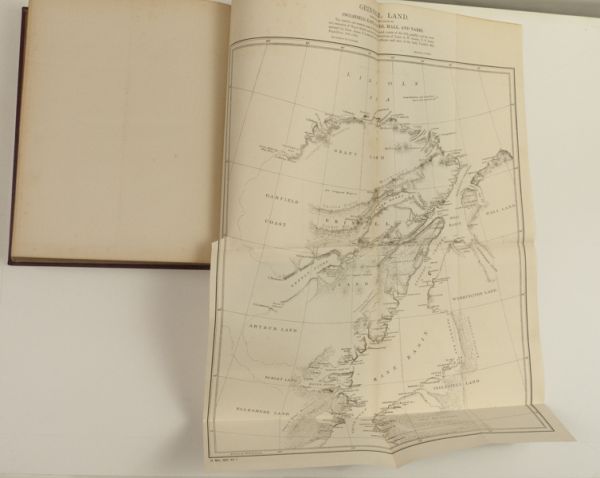
Volume l, 545 pp. including 3 fold-out maps and numerous plates and illustrations.
Volume ll, 738 pp, errata bound in at Contents page, including 6 folding pages providing the results of various scientific observations.
Both volumes professionally rebound in burgundy leatherette with gilt titles on spine. Text clean and crisp; complete and in Near Fine condition. Typically found with institutional markings, but this set bears no prior ownership markings – a very clean set internally.
A concise and detail documentation of The Lady Franklin Bay Expedition commanded by Lt. Adolphus W. Greely. The first 97 pages in Volume I are Greely’s, the rest consists of 128 Appendices of related material. Volume II continues the appendices, and then lists all the scientific results – meteorology, magnetism, tides, pendulum observations, etc. This publication was one of the Arctic Series of Publications issued in connection with the Signal Service , U. S. Army as a result of their participation in the first International Polar Year research endeavor that established 15 stations in the Arctic (12) and Antarctic (3). The ill-fated Lady Franklin Bay Expedition was Lt. Greely’s assignment during this effort. Not in Arctic Bibliography.
Adolphus Greely was a U.S. Army Lieutenant whose scientific expedition to the Arctic resulted in the exploration of a considerable amount of terrain on Ellesmere Island, Canada, and on coastal Greenland, where he also set a contemporary record by reaching 83º24’ N latitude; the mission, however, ended in tragedy. During the first International Polar Year, a joint program of scientific research sponsored by 11 nations (1882-83), Greely commanded the U.S. station at Fort Conger on northeastern Ellesmere Island. From August 1881 to August 1883 the expedition, consisting of 25 officers and men, recorded 500 observations each day on weather and tides and collected and studied samples of minerals, flora, and fauna. Discoveries made on sledge trips included Lake Hazen and Greely Fjord on the western side of Ellesmere. When a relief ship failed to arrive in early August 1883 the party abandoned Fort Conger and moved southward in small boats. Covering 500 miles (805 kilometres) in 51 days, the men landed at Bedford Pym Island in Smith Sound on October 15. There they faced a winter of 250 days with rations for 40 days and, before the ordeal was over, were reduced to eating their own leather clothing. Tragically, only Greely and five others survived.
$450.00 -


