
John Rae Discovers the Dreadful Fate of the Franklin Expedition - in four parts
“From the mutilated state of many of the corpses and the contents of the kettles, it is evident that our wretched countrymen had been driven to the last resource – cannibalism – as a means of prolonging existence …” —John Rae, M.D., Repulse Bay, July 29, 1854
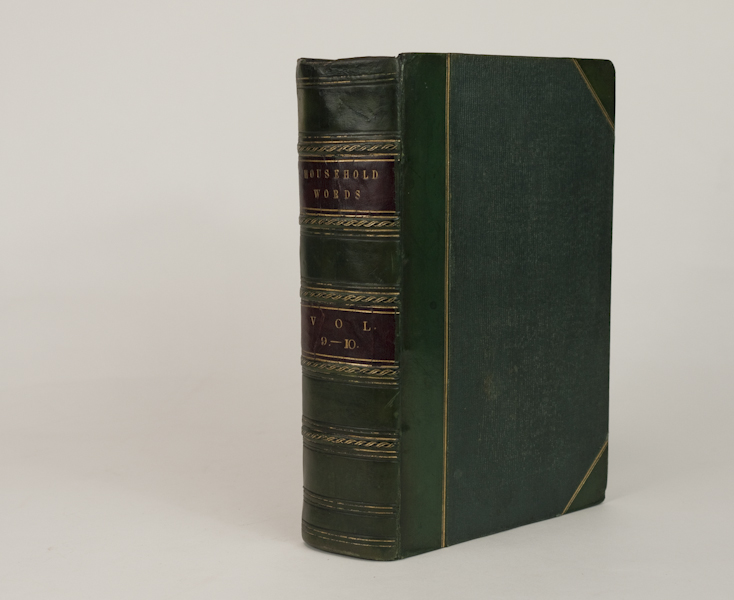
Dr. John Rae / Charles Dickens, The Lost Arctic Voyagers – in three parts. Followed by Dr. Rae’s Report – in one part. London: Office, 1854. First edition. 8vo. Household Words – A Weekly Journal – Conducted by Charles Dickens, Volume 10. The four articles, all published in December 1854, appear on pages 361-365, 385-393, 433-437 (The Lost Arctic Explorers), and 457-459 (Dr. Rae’s Report). Volume 10 is bound together with Volume 9. Contemporary half-green calf and pebbled cloth, gilt-ruled spine in six compartments, red calf lettering pieces, marbled edges. Very light spotting on endpapers. Contemporary bookseller’s ticket on rear paste-down.
Aside from being a prolific novelist, Charles Dickens was also the publisher, editor and major contributor to the weekly journal Household Words, which appeared between 1850and 1859. Dickens shared the British public’s interest in the heroic endeavors of their Arctic explorers, and was deeply affected by the tragic Franklin story. Several weeks after Rae’s “Report to the Admiralty” appeared in The Times and The Illustrated London News, Dickens started a series of articles in Household Words titled “The Lost Arctic Voyagers” in which he closely examined all aspects of the alleged fate of John Franklin and his crew. Although Dickens held Rae in very high regard, he refused to believe Rae’s conclusion that cannibalism had taken place.
In his opening paragraph of the first article, Dickens wrote:
“…there is no reason whatever to believe, that any of its members prolonged their existence by the dreadful expedient of eating the bodies of their dead companions [especially when based on] the very loose and unreliable nature of the Esquimaux representations… and that it is in the highest degree improbable that such men as the officers and crews of the two lost ships would, or could, in any extremity of hunger, alleviate the pains of starvation by this horrible means.”
Over the course of three articles, Dickens picked apart Rae’s “Report to the Admiralty,” and examined the credibility of every shred of evidence. He reviewed the psychology of cannibalism, the Inuit and the reliability of their reports (Dickens was decidedly racist towards non-whites), the possible role of animals in mutilating the dead bodies, and similar instances of near-starvation from published narratives of Franklin and other Arctic explorers. He was emphatic that civilized Europeans would sooner have starved to death rather than resort to eating their deceased comrades, and discussed almost a dozen and a half documented instances of starvation that did not lead to cannibalism.
For the next installment, Rae was invited to contribute a reply. He provided more detail on some aspects of his report, and examined the questions centered around the credibility of the Inuit. Rae had come to know the Inuit during his many years in the Arctic, and knew that they had little or no reason to lie or mislead. Furthermore, he had the utmost respect and confidence in the abilities of his interpreter William Ouligback, who was fluent in the language of the region and understood the dialect of the Inuit informers, and who had excellent command of the English language with which to relay the information.Rae’s defense of the Inuit and the reliability of their reports continued into the fourth and final article of the series (“Dr. Rae’s Report”). Rae was never swayed by any of the criticisms directed at him, and throughout it all, he stood by every word he had written in his original report.
Rae’s report dated September 1, 1854 was published in-full in Volume XI, #254, February 3, 1855, pp. 12-20. This published report is also being offered under a separate listing.
$750.00 -


